Showing posts with label WAR VERSE. Show all posts

Saturday, September 30, 2017

A LOVE-SONG, a poem

THIS is the love-song we today are singing—
     The song of her who, blessing, most is blest:
Giver of dreams that set the soul far winging,
     And bring it home to rest.

This is the song of her, our fount of being,
     The pilot of our hope where'er we go:
Of her—the brave, the patient, the foreseeing—
     To whom our all we owe.

The wronged, oppressed,—what poor, unfriended comer
     Has not, with her, found shelter safe from storm?—
A smile of welcoming as sweet as summer,
     A heart as deep and warm?

Can we have voice today for others' praises,
     When evil and disaster threaten her?
Ah, no! a passion that man's soul upraises,
     New-born in us, doth stir

At thought of her, belov'd, who shows us living
     Is not the mere continuance of breath,
Giving her favored ones a joy of giving,
     Ineffable in death!
"A Love-Song" by Florence Earle Coates. Published in The Bellman (1 December 1917).
Winged Victory in the Court of the Allies,
Philadelphia
Then, even as I grieved, I saw once more
     How genius can atone and re-create:
How, by its own high gift, it can restore
     The Land that gives it birth to sovereign State,
Rekindling glories that it knew before,
     And deepening its life to life as great! 
From "Masefield" (1922) by Florence Earle Coates.


OUR LAND, a poem

THE gift of an idealist,
She came of vision, and the dream
Of one who saw beyond vast waters gleam
The light of a new world without a name:
     A gift of Life she came—.
She, the renascence from Earth's ancient woe,
With Raphael born and Michel Angelo.

Noiseless, the patient years went by,
And only red-men cared to roam
Her glorious streams, and call her mountains home.
Then came to her, like pilgrims of the Grail
     Whose courage could not fail,
Others, sad exiles, longing to be free—
Seekers of God and human liberty!

A blessèd, blessèd Land! She gave
Ideals, to mankind unknown,
And toiling, taught a wondering world to own
The dignity of toil, despised before:
     She opened a great Door;
Enlarged the human mind, and made men see
That he who shares his freedom is most free.

Oh, strong and beautiful and brave,—
The Titan-Mother of the West,—
Gathering in her arms and to her breast
The hurt, unfriended, weary, and forlorn,
     Outcast, and alien-born!
How should the unfriended poor beyond the seas
Not yearn to her—the new Hesperides?. . .

Full garners were her toil's reward;
But, laboring, alway she dreams.
Mistake her not! Mid clouds her eagle screams,
Emblem of liberty that nothing bars,
     And on her brow are stars—
Stars whose pure radiance is not all of earth,
Enkindled there where Justice had its birth.

Belovèd Land! Apart, she smiled!
But, oh, more glorious to-day,
Life's Larger Summons eager to obey,
Her strength outpoured to succor and befriend
     A World, wide without end,
She waits—how yearningly!—the hour to come
When laurelled Peace shall lead her heroes home!
"Our Land" by Florence Earle Coates. Published in Harper's Monthly Magazine (April 1919).

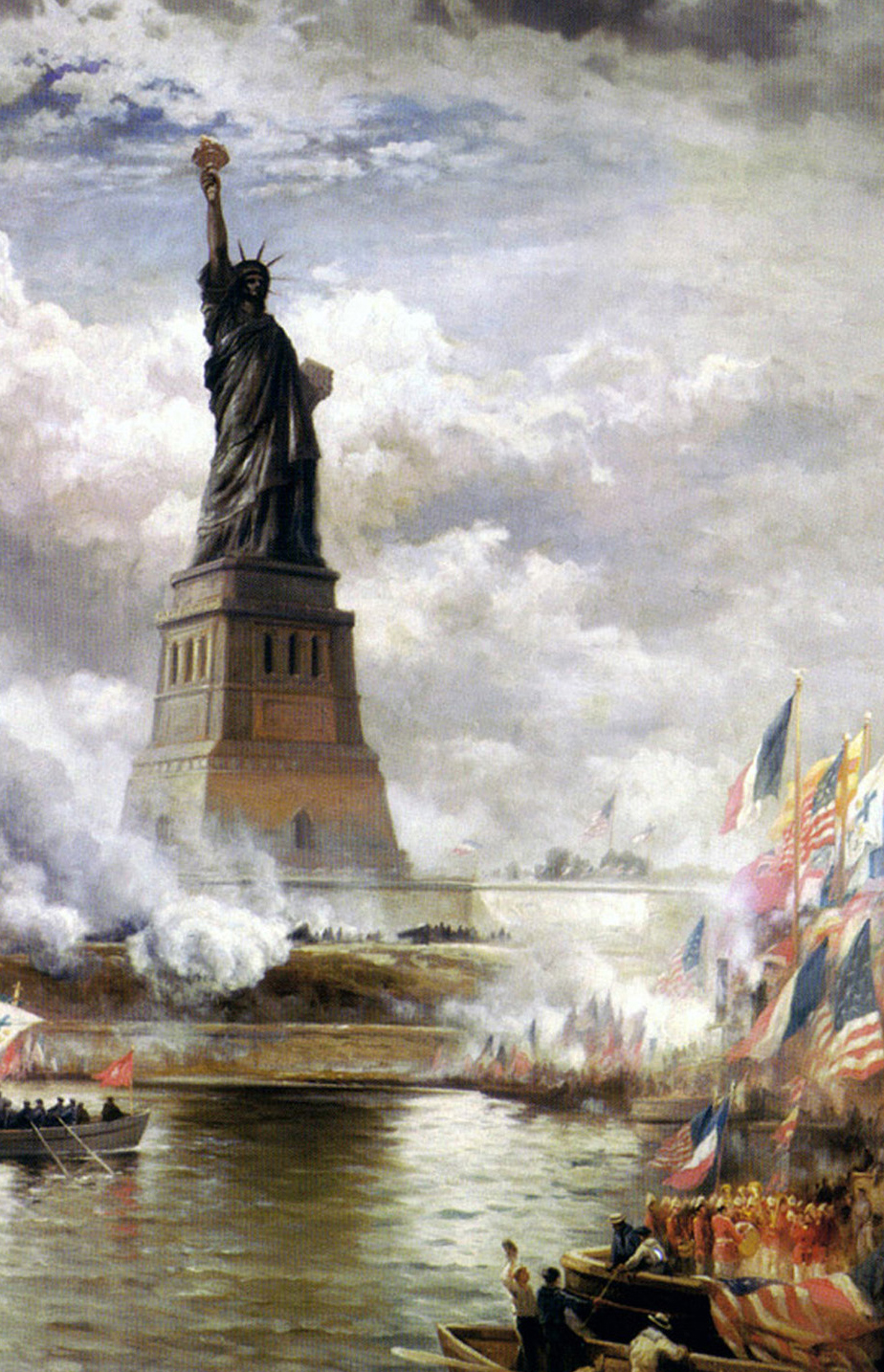
"Unveiling the Statue of Liberty" (1886)
by Edward Moran

Friday, September 29, 2017

IN MEMORY OF AN AMERICAN SOLDIER, a poem

FALLEN IN FRANCE IN THE GLORIOUS YEAR 1918
HE went singing down to death;
     And the high Gods, who heard him,
Gave something of their breath
     To the melodies that stirred him;
Lending some accents to his dying song
That only to abiding things belong.

His boyish heart had laughed
     For joy of life's completeness—
Life had so brimmed the draught
     It held for him with sweetness;
But when, unlooked for, came the suppliant cry
From tortured Lands, he put the full cup by.

Happy whose soul has wings
     And has the strength to spread them!
Happy whose heart still brings
     Its dreams where truth first led them!
Though he give all, his fellow men to save,
He has a tryst with Life, beyond the grave!

Blithely he took the path
     Appointed him by Duty,
Whose face, viewed nearer, hath
     Such deeps undreamed of beauty,—
Love, hope, ambition—he put all aside,
And for the things that do not perish, died.
               *  *  *  *  *  *  *  *
Soul, was it tragedy to fall like this?
Oh,  lovely,  lovely,  lovely,  courage  is!
     And death itself may be most sweet,
Though the lips thirst, and empty be the cup,
If won in climbing—climbing up—and up,
     To heights where vision and fulfilment meet:
If won at last, by deeds that glorify
Our lowly dust, where 'neath an alien sky,
Their service unforgot,
They sleep who, loving greatly, faltered not,—
     The happy brave, who never knew defeat!
"In Memory of an American Soldier" by Florence Earle Coates. Published in The North American Review (June 1919).


Thursday, September 28, 2017

THEIR VICTORY WON, a poem

WAN-VISAGED Azrael, in a darkened room,
'Mid stifled sobs and pleadings full of fear,
     I first was made to know thy presence drear;
And I supposed thee dweller of a tomb
Where quickly fade all fairest things that bloom:
     All loves, ambitions, dreams, that men hold dear.
     But now, O Death, beholding thee more near,
How changed thy look! how glorified thy gloom!

In the wide Open, 'neath a summer sky,
Bending above thy chosen, where they lie
     Upon the hard-won fields of Victory,
This have they taught me—these so young, so brave,
Who smiling gave their all, the world to save—
     Life is not lovelier than death may be!
"Their Victory Won" by Florence Earle Coates. Published in Harper's Monthly Magazine (December 1918).


December 1918 issue of Harper's
In which appears, "Their Victory Won"

Wednesday, September 27, 2017

THE INFANTRY THAT WOULD NOT YIELD, a poem

AH, yes; the French surprise us constantly;
A something in their spirit is so fine!...
I was in Paris when the famous Line
Went through after Verdun, and so could see
How a whole people, putting by its cares,
Came crowding to the well-loved thoroughfares
To view the men—not all—not all, alas!—
Who, in a fateful hour of fear and woe,
Stood as a wall defensive 'gainst the foe,
And said:—They shall not pass!

How surely these had saved her Paris knew—
Heroes who fronting Death turned not aside!
Her heart beat faster as they nearer drew,
And swelled with unimagined love and pride.
Artillery and cavalry went by,—
The plaudits of the people reached the sky!
But for the infantry— At sight of these,
A poignant  silence  fell  upon  the  crowd:
In reverence the people's heads were bowed,
And they were on their knees.

Ah, yes; the French surprise us constantly!
"The Infantry that Would Not Yield" by Florence Earle Coates. Published in The Bellman (14 December 1918).

Tuesday, September 26, 2017

BELGIUM, a poem

Belgium (Mother and Child) (1914) by Charles Webster Hawthorne
as displayed at the World War I and American Art exhibition
at the Pennsylvania Academy of the Fine Arts (2016-17)
     I HAD a dream of Greatness; and I saw—
Not one enthroned, before whose golden crown
And jeweled scepter many bowed them down;

     Not one full-armored who, more fearful awe
Inspiring, with war's pestilential breath
Sowed havoc as he moved, despair and death;

     Nay, in my lofty dream, such greatness paled
Before the image of one nobly fair,
Despite torn raiment and disheveled hair,

     The hope within whose eyes had never failed.
Victim of unrelenting Tyranny
That fain would hold her captive, she is free—

     Stronger, I wis, than e'en her tyrants be—
Because of something that hath never died:
Her glorious, tameless soul, grief-crucified!
"Belgium" by Florence Earle Coates. Published in The Bellman (21 September 1918).

Monday, September 25, 2017

SERBIA, a poem

WHEN the heroic deeds that mark our time
     Shall, in far days to come, recorded be,
     Men, much forgetting, shall remember thee,
Thou central martyr of the Monster-Crime,
Who kept thy soul clear of the ooze and slime—
     The quicksands of deceit and perjury—
     A living thing, unconquered still and free,
Through superhuman sacrifice sublime.

O Serbia! amid thy ruins great,
Love is immortal;  there's an end to hate,
     Always there will be dawn, though dark the night.
Look up, thou tragic Glory! Even now,
The thorny round that binds thy bleeding brow
     Is as a crown irradiating light!
"Serbia" by Florence Earle Coates. Published in A Treasury of War Poetry (1917).

Sunday, September 24, 2017

CAPTAIN GUYNEMER, a poem

Captain Georges Guynemer
(1894-1917)
WHAT high adventure, in what world afar,
Follows to-day,
Mid ampler air,
Heroic Guynemer?
What star,
Of all the myriad planets of our night,
Is by his glowing presence made more bright
Who chose the Dangerous way,
Scorning, while brave men died, ignobly safe to stay?

Into the unknown Vast,
Where few could follow him, he passed,—
On to the gate—the shadowy gate—
Of the Forbidden,
Seeking the knowledge jealous Fate
Had still so carefully from mortals hidden.
With vision falcon-keen,
His eyes beheld what others had not seen,
And his soul, with as clear a gaze,
Pierced through each clouded maze
Straight to the burning heart of things, and knew
The lying from the true.

A dweller in Immensity,
Of naught afraid,
He saw the havoc Tyranny had made,—
Saw the relentless tide of War's advance,
And high of heart and free,
Vowed his young life to Liberty—
And France!

O Compiègne! be proud of him—thy son,—
The greatest of the eagle brood,—
Who with intrepid soul the foe withstood,
And rests, his victories won!
Mourn not uncomforted, but rather say:—
His wings were broken, but he led the way
Where myriad stronger wings shall follow;
For Wrong shall not hold lasting sway,
To break the World's heart, nor betray
With cruel pledges hollow!

To us the battle draweth near.
We dedicate ourselves again,
Remembering, O Compiègne!
Thy Charioteer—
Thy peerless one, who died to make men free,
And in Man's grateful heart shall live immortally!

"Captain Guynemer" by Florence Earle Coates. Published in A Treasury of War Poetry (1917).

SEDAN, a poem

(The battle of Sedan, ending Sept. 2, 1870, in an overwhelming victory for the Prussians and the capture of the Emperor Napoleon III, was the decisive battle of the Franco-Prussian War.)
HOW terrible the victory
     That undermines the soul!
How better, better far to fail—
     To falter from the goal,
And with a brave acceptance meet
The triumph of a high defeat!

France!—generous Land beloved of all!
     More glorious made through pain,
Sedan beheld thy loss,—not fall,
     And taught how men may gain
Conquests that base desires impart,
Corrupt the will, and rob the heart!
"Sedan" by Florence Earle Coates. Published in the Clarion-Ledger (Jackson, Mississippi), 2 September 1917.

Saturday, September 23, 2017

THE COMRADE, a poem

(Among the soldiers of France there is a widespread and touching belief that at Nancy, Soissons, Ypres and in the Argonne a Form in White has passed unharmed through shot and shell, comforting the wounded and the dying.)
WHO is this in raiment white
     Walks across the field,
Midst the terrors of the fight
     Bears nor sword nor shield,
Stays the dying to defend,
Where can come no other friend.

Who is this of whom they tell,
     Beautiful and grave,
As from Heaven, to this Hell
     Come the hurt to save?—
Bearing them with tenderness,
Where can follow no distress?

Who is this that lifts them up
     As they earthward sink,
Bids them, thirsting, from his cup
     Euthanasia drink,
Opens to their closing eyes
Healing visions of the skies?  * * *

Is it the supreme Desire,
     Answering their need?—
Is it Faith that doth aspire,
     Lifting them, indeed,
Up, beyond all human strife,
To its own immortal life?

Is it Hope, the deathless one,
     To their broken hearts
Whispering of joys begun,
     E'en as life departs;
Hope, the gift of memories
Garnered at the mother's knees?

Is it, Friend and Healer, Thou—
     Vision pure and pale—
Whom men, sorrowing, look on now,
     As they saw the Grail?—
Is it Thou their yearnings greet,
Unimaginably sweet?

On the blood-stained fields of France
     What the dying view
Who can tell? All, all, perchance!
     But this much is true:
There wherever pain has trod
Comes the pitying love of God!
"The Comrade" by Florence Earle Coates. Published in The Washington Herald (Washington, DC), 14 June 1918.

FOR FRANCE, a poem

SHE had been stricken, sorely, ere this came;
     And now they wrote that he, her boy, was dead—
     Her only one! Through blinding tears she read,
Trying to see what followed his dear name.
     He had died "gloriously," the letter said,
"Guarding the Tricolor from touch of shame
Where raged the battle furious and wild."
     Catching her breath, she stayed despair’s advance.
She was a mother; but, besides—a child
                      Of France!

And after, though remembrance of past years
     Dulled not to her fond vision nor grew dim;
     Though every slightest incident of him
Was treasured in her breast, she shed no tears.
     Her cup was full now, even to the brim,
And for herself she knew nor hopes nor fears.
So, toiling patiently, with noble pride
     And lifted head she met each pitying glance,
She was the mother of a son who died—
                     For France!
"For France" by Florence Earle Coates. Published in Patriotic Pieces from the Great War (1918).

Friday, September 22, 2017

A SOLDIER, a poem

DEAR God, I raised my boy to be a soldier;
     I tried to make him strong of will and true;
I told him many a tale of deeds heroic—
     The noblest and the sweetest tales I knew.

In thought, he shared the charge at Balaclava,
     With the Swiss Guard, o'ermastered coward Death,
With Gordon all renounced, with Scott and Peary
     Breathed in his ardent youth heroic breath.

A little lad, he wept for wounded Sidney,
     For Bayard, sans reproche, who knew no fears,
Yet, hurt himself, if one but said,—"My Soldier!"—
     Straightaway he smiled and swallowed down his tears.

I taught him that the brave are full of mercy;
     That gentleness and love to strength belong;
That honour is the only High adventure,
     And goodness the one everlasting song!

And so I raised my boy to be a Soldier:
     A patriot soldier, brave, devoted, free!
And now, and now,—with grateful trust, O Father!
     I give him to my Country and to Thee!
"A Soldier" by Florence Earle Coates. Published in The Bellman (20 July 1918).

Thursday, September 21, 2017

AS THEY LEAVE US, a poem

After the cheers had ceased. Photo by Frank W. Buhler.
BID farewell with pride,
     Show no trace of sorrow;
Smile into their eyes,
      Though your courage borrow;
There will be another day,
     And a time
          To pay!

Gallant is their look,
     But their hearts are tender.
Cry aloud your faith!
     Loyal tribute render!
For they go—the young, the brave—
     Liberty
          To save!

Tell them not of fear;
     Whisper not of sadness;
Overbrim to-day
     With heroic gladness;
Let your love, remembered, shine
     As a light
          Benign!

Simple is their trust,
     But 'tis deep as ocean;
Lofty is their hope,
     Selfless their devotion;
And they go—the young, the brave—
     Liberty
          To save!

Hark!  The bugles call!
     Wave your banners!—cheer them!
Happy, let them dream
     All that's valiant near them!
They will know, when far from you,
     That the dream
          Was true!
"As they Leave Us" by Florence Earle Coates. Published in Patriotic Pieces from the Great War (1918).

Wednesday, September 20, 2017

LIVE THY LIFE, a poem

LIVE thy life gallantly and undismayed:
Whatever harms may hide within the shade,
Be thou of fear, my spirit! more afraid.

In earthly pathways evil springeth rife;
But dread not thou, too much, or pain or strife
That plunge thee to the greater depths of life!

What though the storm-cloud holds the bolt that sears?
The eagle of the crag, that nothing fears,
Still, still is young after a hundred years!
"Live Thy Life" by Florence Earle Coates. Published in Scribner's Magazine (January 1914), Poems (1916) Volume I and Pro Patria (1917).

Tuesday, September 19, 2017

THE UNION OF THE FLAGS, a poem

Mayor Smith and Marshal Joffre. Photo by Frank W. Buhler.
The French High Commission visits Philadelphia on 9 May 1917.
May 9, 1917
WE have hung out the flags that we love best—
     The British, the French and our own;
Adoring we see them together,
     That never together were flown!
And we feel in the bond is a blessing
     For every grief to atone.

O flag of my own Land, give welcome!
     Be proud to embrace, fold with fold,
These emblems of service heroic
     Whose measure can never be told:
These banners that speak to the future
     Of honor that shall not grow old!

Across them is ''Sacrifice'' written;
     They voice peoples generous, brave,
Who, suffering all men can suffer
     This side of eternity, gave
Their best with unflinching devotion,
     The wronged and the helpless to save.

They poured out their hearts' blood for freedom;
     They stood in the terrible way,
And bore the full brunt of the onslaught
     That darkened the sun at noonday.
We gaze with dimmed eyes on their Colors,
     Our souls strong for duty as they!

We will stand with high hearts by our Allies,
     With fear of no evil but shame;
We will face coward Death and outface him,
     In Liberty's eloquent name;
For we're of the brood of the Lion
     That Tyranny never could tame!
"The Union of the Flags" by Florence Earle Coates. Published in Pro Patria (1917).

Monday, September 18, 2017

AMERICA SPEAKS, a poem

From Pro Patria (1917)

AMERICA SPEAKS
"For what avail or plough, or sail,
Or land, or life, if freedom fail?"
WE have been sleeping—dreaming.  Now,
     Thank God! we are awake!
Awake, and ready with a will
     The nobler part to take!
No more shall a pretended Peace
     Our souls from duty sever;
We dedicate our lives to God
     And Liberty—forever!

We, who have looked with anguished eyes
     On things no eye should see,
Beholding all that may be wrought
     By ruthless Tyranny,
Join hands with you, devoted Lands,
     A liberated Nation
That wills to share your sacrifice,
     That knows your exaltation!

A lofty voice has spoken words
     That bring the world relief;
Our Land has joined the league of Right,
     Led onward by her Chief—
Her Chief who large has writ his name
     With Lincoln's in the story
Of that dear land which still may call
     The flag she loves, "Old Glory!"
"America Speaks" by Florence Earle Coates. Published in Pro Patria (1917).

Sunday, September 17, 2017

UNDER THE FLAG, a poem

February 5, 1917
UNDER our own flag, still we will sail her—
     Gallantly sail her, our own Ship of State;
Faiths we have lived by still shall avail her,
     Hope at her prow, wing'd, expectant, elate!

Over the deeps of a perilous ocean,
     Honor compelling, we still will sail on;
Giving, unfearing, a loyal devotion,
     Until, in life—in death, danger is gone.

Deem not that we, whom our fathers before us
     Taught to love freedom and died to make free,
Coward shall fly, while the Heavens are o'er us,
     Craft of the ether or boats under sea.

There is in valor that hearkens to duty—
     Something that dearer may be than long years;
And in man's service may be a beauty
     Higher than glory, and deeper than tears.
"Under the Flag" by Florence Earle Coates. Published in Pro Patria (1917).

This poem was cited by the Hon. Isaac Siegel in an "Extension of Remarks" in the Appendix to the Congressional Record (Second Session of the 64th Congress of the United States, Vol. LIV) on 2 March 1917, under the heading, "Arming of American Merchant Ships."  Mr. Siegel referenced a February 1917 publishing of the poem from The New York Times, but no specific edition of the Times is given.

Saturday, September 16, 2017

THE AMERICAN PEOPLE TO THE ALLIES, a poem

IF they tell you that we hold
     Right and wrong are much the same:
     That with equal share of blame
The defender of the fold
     And the ravening wolf we name—
               Don't believe it!

If they tell you that we think,
     When the robber comes by night
     And we see 'neath murderous Might
Innocence unfriended sink,
     We should be "too proud to fight"—
               Don't believe it!

If they tell you we are cold
     When strong men, and maids as brave,
     May not life from bondage save—
We who gave unstinted gold,
     And our heart's blood, for the slave!—
               Don't believe it!

If—O gallant souls and true!—
     If they tell you we judge well
     Ways of Heaven and ways of Hell:
That the honor dear to you
     Also in our souls doth dwell—
               Oh, believe it!

If they tell you our heart's cry:
     That, whate'er the danger near,
     One, one only loss we fear;
And are ready, too, to—die
     For the things that you hold dear—
               Oh, believe it!
"The American People to the Allies" by Florence Earle Coates. Published in Pro Patria (1917).

The "too proud to fight" reference in the poem refers to the words of President Woodrow Wilson from a speech delivered on 10 May 1915 to 4,000 newly naturalized citizens in Convention Hall, Philadelphia. Mr. Wilson stated that "there is such a thing as a man being too proud to fight ... as a nation being so right that it does not need to convince others by force that it is right." Mrs. Coates evidently disagreed with Mr. Wilson on that point.

Friday, September 15, 2017

AMERICA, a poem

PATIENT she is—long-suffering, our Land;
     Wise with the strength of one whose soul in calm
Weighs and considers, and would understand
     Ere it gives way to anger: fearing wrong
Of her own doing more than any planned
     Against her peace by others deemed more strong.

Mother of many children alien born,
     Whom she has gathered into her kind arms,—
Safe-guarding most the weakest, most forlorn,—
     The mother's patience she has learned to know,
Which passes trifles by with smiling scorn—
     The mother's hopefulness, to anger slow.

Yet, oh, beware! nor, over-bold, presume
     Upon a gentleness enlikened with Power!
Her torch still burns, to kindle or consume,
     And 'gainst the time when she must prove her might,
Vast energy is stored in her soul's room—
     Undreamed of strength to battle for the Right!
"America" by Florence Earle Coates. Published in Pro Patria (1917) and in the New York Times Magazine (25 February 1917).

Thursday, September 14, 2017

BETTER TO DIE, a poem

BETTER to die, where gallant men are dying,
     Than to live on with them that basely fly:
Better to fall, the soulless Fates defying,
Than unassailed to wander vainly, trying
     To turn one's face from an accusing sky!

Days matter not, nor years to the  undaunted;
     To live is nothing,—but to nobly live!
The poorest visions of the honor-haunted
Are better worth than pleasure-masks enchanted,
     And they win life who life for others give.

The planets in their watchful course behold them—
     To live is nothing,—but to nobly live!—
For though the Earth with mother-hands remold them,
Though Ocean in his billowy arms enfold them,
     They are as gods, who life to others give!
"Better to Die" is the first poem in Florence Earle Coates' pamphlet of poetry, Pro Patria (1917), created in support of American involvement in WWI. It was also published in The Unconquered Air (1912) and Poems (1916) Volume I.


Pro Patria (1917)